Learn how to distinguish normal post-exercise fatigue from signs of pain in a senior dog with arthritis, and know when to slow down or seek veterinary advice.
For many senior dogs, a little extra tiredness after a walk or gentle activity is completely normal. However, dog pain after exercise can sometimes look surprisingly similar to ordinary fatigue, especially in dogs living with arthritis.
They may lie down for a while, drink some water, sleep more deeply, or simply seem quieter than usual. Older dogs often need more recovery time than they did when they were younger.
The important question, therefore, is not simply whether your dog is tired.
It is how your dog behaves while recovering.
The Difference Between Being Tired and Being in Pain
A tired dog usually looks comfortable.
After activity, they may settle into a favorite resting position, breathe a little faster for a short period, and gradually return to their normal behavior. Once they have rested, they should generally be able to get up and move without a noticeable decline in comfort.
Pain can look different.
Dogs do not always cry, whimper, or limp when something hurts. In fact, pain can appear through subtle changes in posture, movement, interaction, or routine. Veterinary guidance notes that dogs may hide pain, making changes in everyday behavior particularly important to notice. VCA Animal Hospitals: Signs of Pain in Dogs
For a senior dog with arthritis, therefore, the recovery period can tell you a great deal.
What Normal Post-Exercise Fatigue Can Look Like
Imagine your senior dog has just finished a short, comfortable walk.
They come inside, drink some water, and settle down on their bed. Perhaps they sleep for an hour or two. Later, they get up, stretch, walk toward you, and show interest in what is happening around the house.
That is generally reassuring.
Normal tiredness may include:
- wanting to rest after activity;
- sleeping more than usual for a short period;
- temporarily moving at a slower pace;
- drinking water after exercise;
- relaxing once they have settled;
- returning to their usual behavior after adequate rest.
The key is recovery.
If your dog gradually returns to their normal movement and behavior, the activity may have been appropriate for their current fitness and comfort level.
Of course, every dog is different. A senior Labrador and a senior Dachshund may have very different exercise needs, even when both have arthritis.
Signs That Your Dog May Be Experiencing Pain
Pain becomes more concerning when your dog’s behavior changes in a way that is unusual for them.
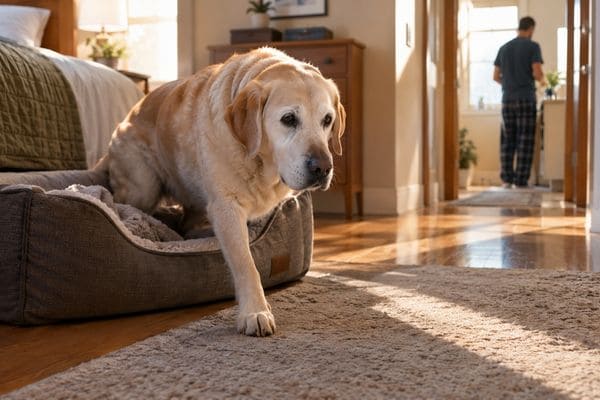
For example, your dog may have been walking normally before the activity but become noticeably stiff afterward. They may hesitate before standing, struggle to rise from their bed, or avoid putting weight on one leg.
Other signs can include:
- limping or an altered gait;
- difficulty getting up after resting;
- reluctance to climb stairs;
- hesitation before jumping onto furniture;
- repeatedly changing positions because they cannot get comfortable;
- becoming unusually quiet or withdrawn;
- resisting touch or handling;
- appearing restless rather than peacefully tired;
- shortening the next walk or refusing normal activities;
- shifting weight away from a particular limb;
- showing a hunched or unusual posture.
These signs do not automatically prove that exercise caused the pain. Arthritis symptoms can fluctuate, and other health problems can also affect mobility.
Nevertheless, a noticeable change deserves attention.
VCA identifies changes such as difficulty rising, slower movement, reduced stamina, reluctance to use stairs or jump, and lameness among signs that can occur with osteoarthritis in dogs.
Pay Attention to What Happens When Your Dog Gets Up
One of the simplest observations you can make is what happens after your dog has been resting.
A tired dog may sleep deeply and then get up normally.
A painful dog may hesitate.
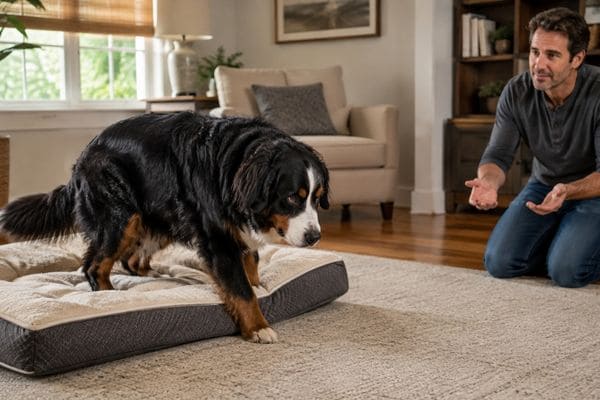
You might notice your dog preparing to stand, shifting their weight several times, pushing themselves up slowly, or remaining in place instead of following you.
Sometimes the difference is very subtle.
That is why it helps to compare your dog’s behavior with their normal baseline rather than looking for one universal sign of pain.
If your dog usually stands easily but suddenly struggles after a particular activity, that change is meaningful.
For senior dogs with arthritis, getting up can be especially informative because stiffness and joint discomfort often become more obvious after periods of rest.
🔗 How to Help a Dog with Arthritis Get Up Safely
Watch the Hours After Exercise, Not Just the Walk
One common mistake is judging an activity only by what happens during it.
Your dog may happily complete a walk, sniff along the way, and appear completely comfortable. Yet several hours later, they may become much stiffer.
That delayed change matters.
Instead of asking only, “Did my dog enjoy the walk?”, consider asking:
“How did my dog feel afterward?”
This broader perspective can help you recognize patterns.
For instance, perhaps your dog handles a 20-minute walk well on one day but becomes noticeably stiff later that evening. If the same thing happens repeatedly, the duration, pace, surface, or overall intensity may need to be reassessed with your veterinarian.
Controlled exercise is generally beneficial for dogs with osteoarthritis, but veterinary guidance emphasizes adjusting activity according to the individual dog’s response.
🔗 Safe Walks for Senior Dogs with Arthritis: Keep Your Dog Active
What About the Next Morning?
The following morning can provide another useful clue.
If your dog wakes up comfortably, gets out of bed without unusual hesitation, and moves similarly to their normal pattern, that is reassuring.
On the other hand, a clear increase in morning stiffness after a particular activity may suggest that the previous session was more demanding than your dog could comfortably tolerate.
This does not mean your dog should stop exercising.
Quite the opposite.
Regular, controlled movement is an important part of managing osteoarthritis because it can help maintain muscle strength, mobility, and overall fitness. The goal is to find an amount and type of activity that your dog can recover from comfortably.
Look for Patterns Instead of Judging One Bad Day
Senior dogs can have good days and difficult days.
Weather, sleep, excitement, footing, stress, body condition, and the underlying arthritis itself can influence how a dog moves.
Therefore, one unusually tired afternoon does not necessarily mean that something is seriously wrong.
Instead, look for patterns.
You might keep a simple note of:
- what activity your dog did;
- approximately how long it lasted;
- how your dog behaved immediately afterward;
- how easily they got up later;
- how they moved that evening;
- how they looked the following morning.
Over time, these observations can reveal useful patterns.
For example, you may discover that your dog does well with several short walks but becomes uncomfortable after one longer outing. That information can be far more useful than simply deciding that your dog “cannot exercise anymore.”
Sometimes the Surface Matters as Much as the Distance
The amount of exercise is not the only factor.
A short walk on a slippery, uneven, or steep surface can be more demanding than a slightly longer walk on stable, comfortable footing.
For an arthritic dog, every step may require additional effort when balance and joint movement are compromised.
If your dog seems comfortable on one route but struggles after another, consider what changed.
Was the surface harder?
Were there more hills?
Did your dog have to climb stairs?
Was the ground wet or slippery?
Did your dog spend more time standing rather than walking?
These details can help explain why two activities that appear similar on paper produce very different results.
📌 [IMAGE 1 – INSERT HERE]
Caption:
The walking surface and pace can influence how comfortably an arthritic dog recovers after activity.
Alt Text:
Senior Beagle walking slowly along a level garden path while its owner follows behind.
What You Should Do If Your Dog Seems Sore
If your dog appears mildly uncomfortable after activity, the first step is usually not to push through it with more exercise.
Give your dog an opportunity to rest in a comfortable, safe environment.
Make sure they have easy access to water and a supportive resting area. Avoid encouraging additional strenuous activity while you are trying to understand what happened.
Then observe.
Does your dog gradually return to their normal behavior?
Do they continue to struggle when standing?
Are they reluctant to walk?
Is the discomfort becoming more obvious?
A pattern of increased stiffness or soreness after exercise is worth discussing with your veterinarian. The exercise plan or broader pain-management strategy may need to be reassessed.
Do Not Automatically Assume Your Dog Needs More Rest
It can be tempting to think that a painful senior dog simply needs to stop exercising.
That approach can create another problem.
When dogs move less and less, they can lose muscle strength and physical conditioning. Reduced activity can also contribute to weight gain, which may place additional stress on already painful joints.
Instead, the objective is usually appropriate movement, not complete inactivity.
A veterinarian or qualified rehabilitation professional can help determine what type and amount of exercise is appropriate for your dog’s condition.
Physical rehabilitation can also be useful for assessing movement and adjusting activity according to individual needs.
When Fatigue Becomes a Reason to Call the Veterinarian
Some changes should not simply be watched at home.
Contact your veterinarian if your senior dog repeatedly shows significant stiffness, lameness, difficulty standing, unusual reluctance to move, or a clear decline in stamina.
Likewise, seek veterinary advice if your dog suddenly develops a substantial change in mobility or behavior.
Pain can be difficult to assess from the outside, and reduced stamina is not always caused by arthritis. Other medical conditions can produce similar changes, which is why persistent or significant changes deserve professional evaluation.
If your dog appears to be in severe pain, cannot use a limb normally, suddenly becomes unable to stand or walk, or develops another acute and concerning symptom, prompt veterinary attention is appropriate.
A Simple Recovery Check You Can Use at Home
After your dog’s next activity, take a few minutes to observe rather than immediately deciding whether everything went well.
Ask yourself:
How does my dog look?
Relaxed and comfortable, or tense and unsettled?
How does my dog stand up?
Normally, or with hesitation and difficulty?
How does my dog walk afterward?
Similar to normal, or noticeably slower, uneven, or reluctant?
Does my dog want to interact?
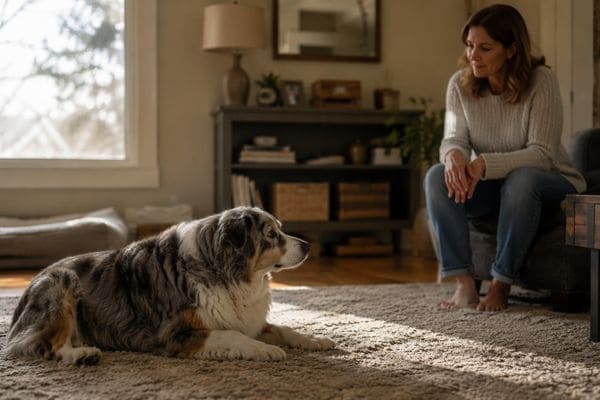
A tired dog may want quiet time but still behave normally when approached.
What happens later?
Does your dog recover gradually, or does stiffness and discomfort become more noticeable?
This simple routine can help you become much more familiar with your dog’s individual signals.
📌 [IMAGE 2 – INSERT HERE]
Caption:
Quiet recovery time can help owners notice whether a senior dog is settling comfortably after activity.
Alt Text:
Senior Cocker Spaniel resting on a mat while its owner prepares water nearby.
How to Make Exercise Easier to Evaluate
Consistency can make this process much easier.
Rather than constantly changing the length, pace, location, and type of activity, keep your dog’s routine relatively predictable while you observe their response.
For example, if your veterinarian has recommended short walks, you might keep the route and pace similar for several days. That gives you a better opportunity to notice whether your dog is comfortable with that level of activity.
If something changes, you have a clearer idea of what might have contributed.
This is particularly useful for senior dogs whose mobility changes gradually.
Recovery Is Part of the Exercise Plan
Exercise should not be viewed as the moment your dog is moving and everything afterward as irrelevant.
Recovery is part of the picture.
A good activity should fit into your dog’s entire day without leaving them struggling for the hours that follow.
That may mean choosing shorter walks, adding rest between activities, avoiding unnecessary jumping, or selecting safer walking surfaces. In some dogs, several brief sessions may be more manageable than one long outing.
The right routine is therefore not necessarily the one that makes your dog tired.
It is the one that allows your dog to move, enjoy their surroundings, and still feel comfortable afterward.
📌 [IMAGE 3 – INSERT HERE]
Caption:
The goal of exercise is not exhaustion. It is comfortable movement that fits into the whole day.
Alt Text:
Senior Labrador Retriever walking calmly beside its owner on a quiet tree-lined path.
Your Dog’s Recovery Can Teach You a Lot
Senior dogs often communicate through small changes rather than dramatic signals.
A slightly slower rise from bed.
A hesitation before taking the first steps.
A decision to stop following you.
A reluctance to climb onto a favorite piece of furniture.
A quieter evening after what seemed like an ordinary walk.
Individually, these signs may be easy to overlook. Together, however, they can tell an important story.
Most importantly, do not think of fatigue and pain as completely separate categories. A dog can be genuinely tired and also uncomfortable.
The goal is to learn your dog’s normal recovery pattern well enough to recognize when something has changed.
With appropriate exercise, veterinary guidance, and thoughtful observation, movement can remain an important part of a senior dog’s quality of life without turning every walk into a test of endurance.
Sometimes, the most helpful thing you can do is not ask how far your dog managed to walk.
Ask how comfortably they lived the rest of the day.