Learn how to choose the right mobility aid for your senior dog based on the everyday challenges caused by arthritis, stiffness, weakness, and reduced confidence.
There comes a point in a senior dog’s life when ordinary movements start to look different.
Getting off the bed may take longer. Crossing a slippery floor may require extra caution. A favorite couch may suddenly become too high, and a short walk may leave your dog needing more rest than before.
For an owner, these changes can be difficult to watch.
Fortunately, helping your dog does not always mean buying every mobility product available. In fact, choosing the right mobility aid starts with understanding what your dog is struggling with most.
A ramp may be extremely helpful for one dog but unnecessary for another. Similarly, a support harness can provide valuable assistance to a dog with hind-leg weakness, while a non-slip rug may make a much greater difference for a dog that struggles to maintain traction indoors.
The goal is not to add more equipment.
It is to find the right support for the movement that has become difficult.
Start With the Problem, Not the Product
When arthritis affects mobility, it is tempting to start searching for products immediately.
However, that approach can lead to buying equipment your dog does not actually need.
Instead, spend a few days observing your dog’s normal routine.
Notice how they get up. Watch them walk across different surfaces. Pay attention to stairs, furniture, feeding areas, and the places where they usually rest.
Most importantly, look for moments of hesitation.
Does your dog stop before climbing onto the couch? Do their paws slide on the floor? Do they struggle to rise after sleeping? Are they comfortable walking but unable to manage stairs?
These details provide valuable clues.
Once you identify the specific challenge, choosing an appropriate mobility aid becomes much easier.
If Your Dog Struggles With Slippery Floors
Slippery flooring is one of the most common environmental challenges for dogs with reduced mobility.
Hardwood, tile, laminate, and polished floors can make it difficult for a senior dog to gain traction. Even when a dog has enough strength to stand, their paws may slide when they try to push themselves forward.
That can create more than physical discomfort.
Repeated slipping can make a dog nervous about moving around the home. Eventually, they may avoid certain rooms or walk with excessive caution.
In this situation, floor traction should usually be one of the first solutions to consider.
Non-slip rugs, runners, and secure mats can create safer pathways between the dog’s bed, food area, and favorite resting places.
If your dog has frequent difficulty on household floors, our guide on The 5 Best Non-Slip Rugs for Dogs with Arthritis can help you evaluate what to look for.
The important point is that the rug should remain firmly in place. A loose mat can create another tripping hazard instead of solving the original problem.
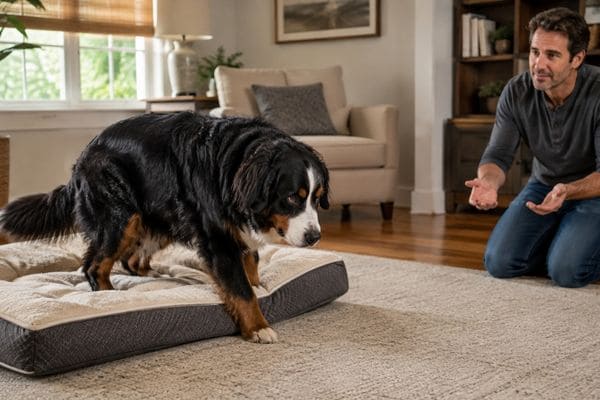
📌 [IMAGE 1 – INSERT HERE]
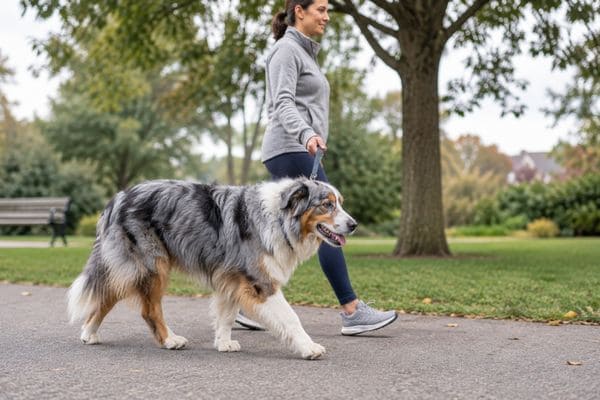
A calm, low-impact walk can help a senior dog with arthritis stay active while respecting its comfortable pace.
If Getting Up Is the Biggest Challenge
Some dogs move reasonably well once they are standing but struggle during the transition from lying down to standing.
This can happen after a long nap or first thing in the morning. Joint stiffness, muscle weakness, and discomfort may make the initial movement particularly difficult.
In these cases, a mobility support harness may be more appropriate than a ramp or a set of stairs.
A properly fitted support harness can give the owner a controlled way to assist the dog while reducing the temptation to pull on the collar or legs.
However, assistance should be gentle.
The purpose is to support the dog’s movement, not to lift their entire body unnecessarily.
If your dog frequently struggles to rise, you may also want to review How to Help a Dog with Arthritis Get Up Safely for practical guidance on assisting during this particular movement.
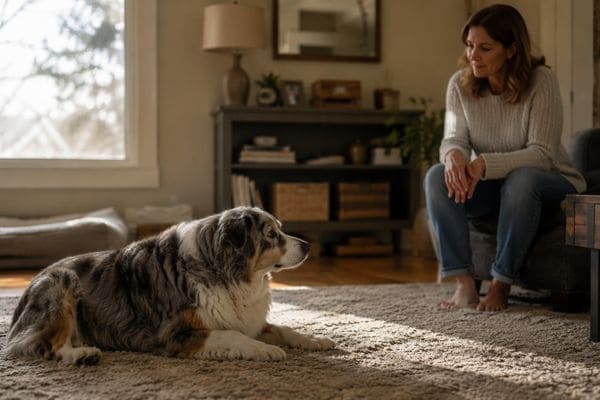
📌 [IMAGE 2 – INSERT HERE]
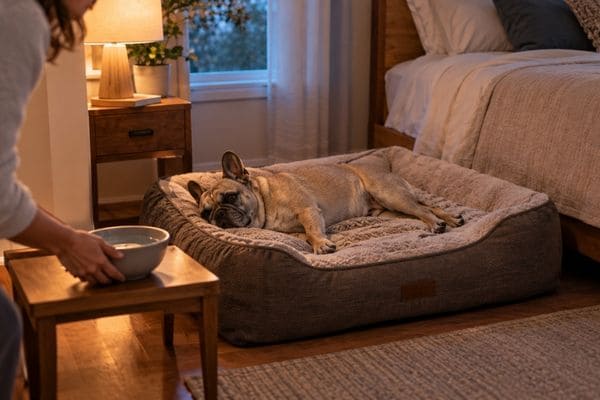
A calm evening environment gives a senior dog with arthritis time to rest, recover, and settle comfortably for the night.
If Your Dog Hesitates Before the Couch or Bed
Perhaps your dog can walk normally but has stopped jumping onto furniture.
This is an important distinction.
The problem may not be general mobility. Instead, your dog may be reacting to the impact and joint strain associated with jumping.
For these situations, a ramp or carefully designed pet steps can provide an easier route to elevated areas.
Ramps are particularly useful when a dog needs to access a couch, bed, vehicle, or another elevated location regularly.
Before choosing one, consider the slope, surface traction, width, and stability. A ramp that moves under your dog’s weight may create fear rather than confidence.
Also, remember that a mobility aid should match the dog’s physical ability. A very steep ramp may be technically available but practically unusable for a dog with significant stiffness.
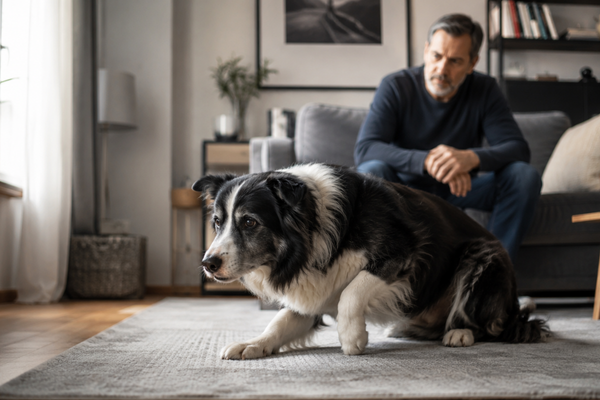
📌 [IMAGE 3 – INSERT HERE]
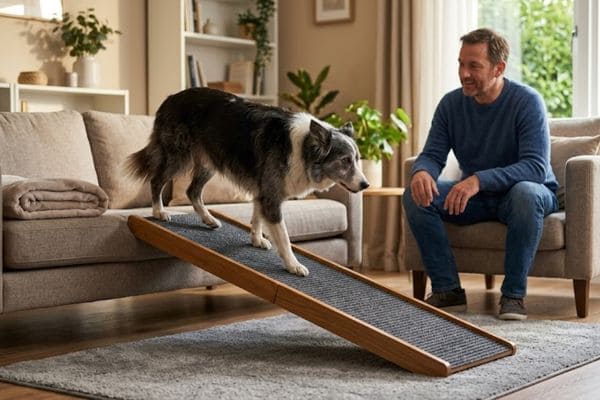
A properly designed ramp can remove the impact of jumping while preserving access to familiar places.
If Your Dog Needs More Support During Walking
Not every dog with arthritis needs support while walking.
Some senior dogs remain capable of walking independently but become less stable when they are tired. Others may experience weakness in the hind legs or have difficulty navigating uneven surfaces.
For these dogs, a support harness can provide additional control when necessary.
The advantage is that the owner can offer assistance without constantly forcing the dog to move in a particular way.
A harness can be particularly useful during transitions, short outdoor walks, stairs, or moments when the dog becomes fatigued.
Nevertheless, it should not replace appropriate exercise or veterinary assessment. If your dog’s walking ability is changing noticeably, it is important to understand why.
If Resting and Getting Comfortable Are Becoming Difficult
Mobility is not only about walking.
Rest is equally important.
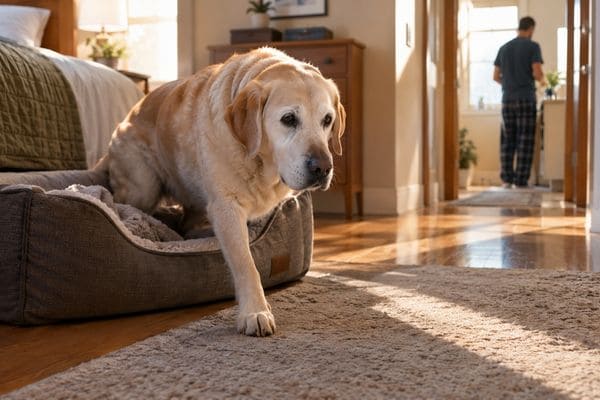
An arthritic dog may spend many hours lying down, so the quality of the resting surface can influence how comfortable they feel throughout the day.
If your dog frequently changes position, struggles to settle, or seems stiff after getting up from their bed, consider whether the resting area provides enough support.
An orthopedic dog bed can distribute body weight more evenly and provide a more supportive surface for dogs with joint discomfort.
The bed should also be easy to enter and leave.
A very high-sided bed may look comfortable but can become another obstacle for a dog with limited mobility.
For more guidance, see Best Orthopedic Dog Beds for Senior Dogs with Arthritis.
If Cold Weather Makes Movement More Difficult
Some dogs appear noticeably stiffer during colder periods.
When this happens, the best solution may not be a mobility device at all.
A warm, comfortable resting area can make daily movement easier by helping your dog avoid prolonged exposure to cold floors and uncomfortable resting conditions.
Soft bedding, appropriate blankets, and a draft-free sleeping area may be simple additions that improve comfort.
At the same time, avoid excessive heat or direct heat sources that could burn your dog.
If your dog’s stiffness seems to change significantly with temperature, How Cold Weather Affects Dogs with Arthritis provides additional information about creating a more comfortable
What If Your Dog Has More Than One Mobility Problem?
This is where choosing mobility aids can become confusing.
A dog may slip on the floor, struggle to get up, and hesitate before climbing onto the couch.
That does not necessarily mean you need three different products immediately.
Start with the problem that affects your dog’s safety most often.
For example, if your dog slips several times a day, improving floor traction may be the first priority. Once the environment is safer, you can determine whether additional support is still necessary.
Similarly, if getting up is clearly the biggest challenge, appropriate assistance during that transition may provide more value than buying equipment for occasional situations.
Think in terms of priorities rather than products.
The simplest effective solution is often the best place to begin.
How to Know If a Mobility Aid Is Actually Helping
Buying a mobility aid is only the beginning.
Your dog’s response is what matters most.
After introducing a new product, observe how your dog behaves.
Are they moving with greater confidence? Do they hesitate less? Are they able to reach important areas of the house more easily? Do they seem calmer during movement?
On the other hand, watch for signs that something is not working.
Your dog may resist the equipment, move unnaturally, become more anxious, or show signs of discomfort.
If that happens, stop and reassess.
A product should make movement easier, not force your dog into a movement pattern they cannot comfortably manage.
Avoid Choosing a Mobility Aid Based Only on Size or Appearance
A product can look impressive and still be wrong for your dog.
For example, a large ramp may seem more supportive, but if your dog is unwilling or unable to walk up the incline, it will not solve the problem.
Likewise, a harness that fits another dog perfectly may not provide appropriate support for your dog’s body shape.
Comfort and fit matter.
Before purchasing anything, consider your dog’s size, strength, mobility level, the areas where support is needed, and how often the equipment will actually be used.
When possible, professional guidance is also valuable, particularly if your dog’s mobility has declined quickly.
When a Mobility Aid Should Not Be the Only Solution
Mobility aids can make daily life easier, but they do not treat the underlying cause of pain.
If your dog suddenly becomes reluctant to walk, repeatedly falls, cries when moving, refuses to stand, or experiences a significant change in mobility, a veterinary evaluation is important.
A new mobility problem may indicate that arthritis has progressed, but other conditions can also affect movement.
Therefore, equipment should be considered part of a broader care strategy rather than a substitute for veterinary assessment.
Building a Supportive Environment Around Your Dog
The most effective mobility strategy is rarely based on one product.
Instead, it comes from creating an environment where your dog does not have to fight against unnecessary obstacles.
A clear path through the home can reduce awkward movements. Non-slip surfaces can improve traction. A supportive bed can make rest more comfortable. A ramp can eliminate repeated jumping.
Together, these changes can make everyday life feel much easier.
And because each dog experiences arthritis differently, the best setup may change over time.
What works today may need adjustment several months from now.
Choosing Support That Preserves Independence
Helping a senior dog does not mean doing every movement for them.
Whenever it is safe, encourage your dog to remain involved in their own movement.
The right mobility aid should provide support without unnecessarily taking away independence.
That distinction matters.
A ramp allows a dog to reach a favorite place without jumping. A non-slip runner allows them to walk with greater confidence. A properly fitted harness can provide assistance when strength is limited.
These tools do not replace your dog’s movement.
They make movement more achievable.
Small Adjustments Can Make a Big Difference
There is no single mobility aid that is perfect for every senior dog with arthritis.
The right choice depends on what your dog struggles with, where the difficulty occurs, and how much support they need.
Start by observing.
Then identify the most important problem. From there, choose the simplest appropriate solution and monitor how your dog responds.
Over time, these small decisions can change the way your dog experiences everyday life.
A safer floor can make a room accessible again. A ramp can restore access to a favorite couch. A supportive harness can make a difficult transition less frightening.
For an aging dog, those moments matter.
Because improving mobility is not simply about helping a dog move farther.
It is about helping them continue to participate in the life they know and love, with greater comfort, confidence, and dignity.